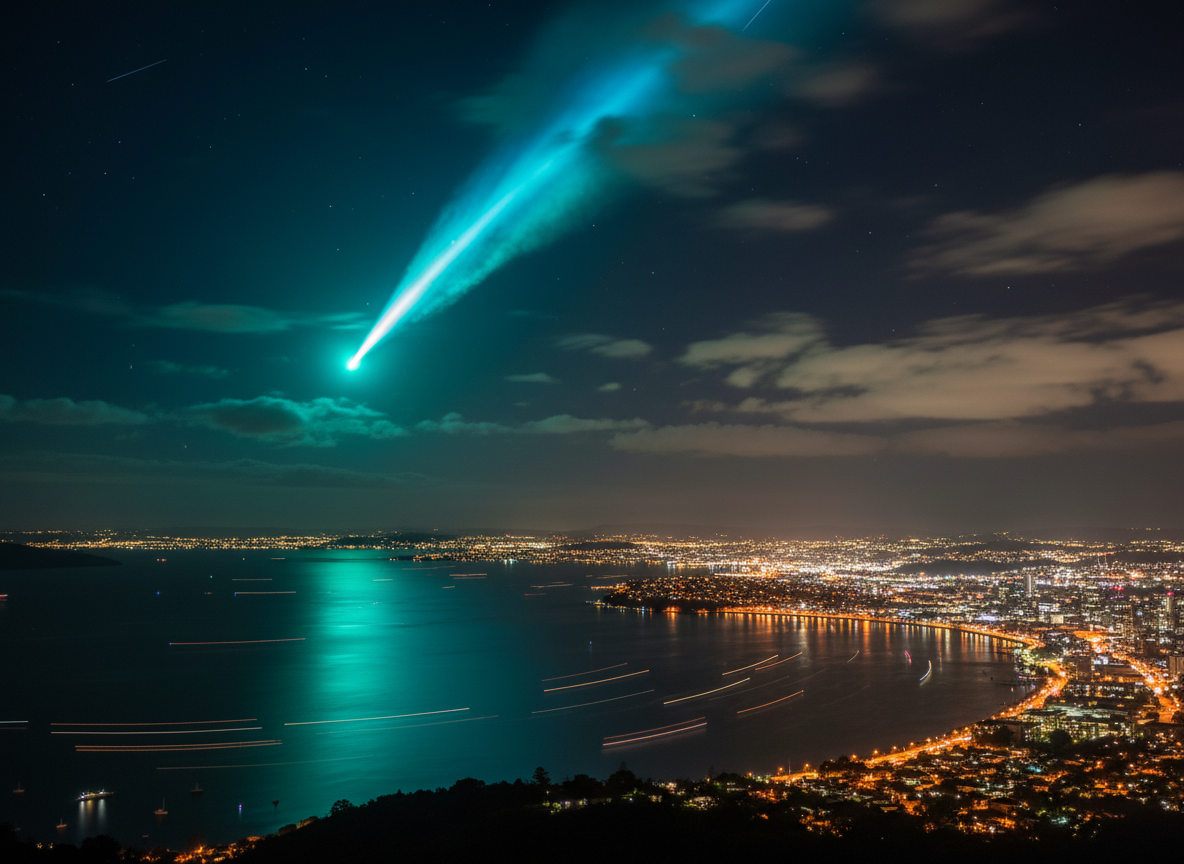
Massive Fireball Meteor Illuminates Wellington Harbor as Experts Distinguish from Rocket Debris
A dazzling blue and green light streaked across the New Zealand night sky on January 30, 2026, the event stunned witnesses in Wellington around 11:25 PM local time. While initial fears pointed to falling space junk, scientists have identified the object as a natural fireball meteor.
Rising Confusion Over Orbital Debris
New Zealand has recently experienced a surge in reported aerial phenomena, this trend includes a notable meteorite recovery on the South Island in 2024. The sighting on January 30 caused immediate speculation due to the scheduled return of a massive artificial object, an 11 ton stage from a Chinese rocket was predicted to fall nearby. Global tracking data confirmed the hardware launched in late 2025, it eventually disintegrated over the ocean significantly earlier in the day. This coincidence highlights the growing difficulty in distinguishing natural meteors from human made waste, the country is increasingly vigilant given its status as a frequent launch site for orbital missions.
Cameras Record Rare Atmospheric Entry
A webcam positioned at the Heretaunga Boating Club provided the most definitive evidence of the event, the footage shows a bright flare reflecting vividly off the harbor waters. The Canterbury Astronomical Society utilized their specialized camera array to track the object, they noted a smoke trail that lingered in the upper atmosphere for over five minutes. Experts examined the speed and disintegration pattern of the object, the sharp and clean light trail indicated a high velocity meteor rather than slow moving debris. Witnesses reported the spectacle from Tītahi Bay all the way to the northern regions of the South Island, the visual range confirms the significant altitude of the object.
Distinguishing Natural from Artificial
Data confirms the unrelated rocket stage entered the atmosphere at 1:39 AM the same day, this occurred nearly 800 kilometers south of the country. The visual characteristics differed significantly from structural debris, space junk typically breaks apart into multiple glowing fragments while this object remained singular. The intense speed of the fireball suggests it was a larger space rock, it burned up completely due to friction with the air.
Citizen Science Aids Planetary Defense
This event underscores the value of public observation networks in modern astronomy, groups like Citizen science organizations rely on community reports to triangulate landing sites. The data collected helps researchers understand the composition of asteroids entering our atmosphere, this specific incident caused no damage to property or infrastructure. Officials confirmed that no public safety alerts were necessary, the light show served primarily as an educational opportunity for local observers.
Scientific bodies are currently reviewing all submitted footage to refine their trajectory models, they hope to determine if any fragments reached the ground. Astronomers urge the public to keep cameras ready for future displays.