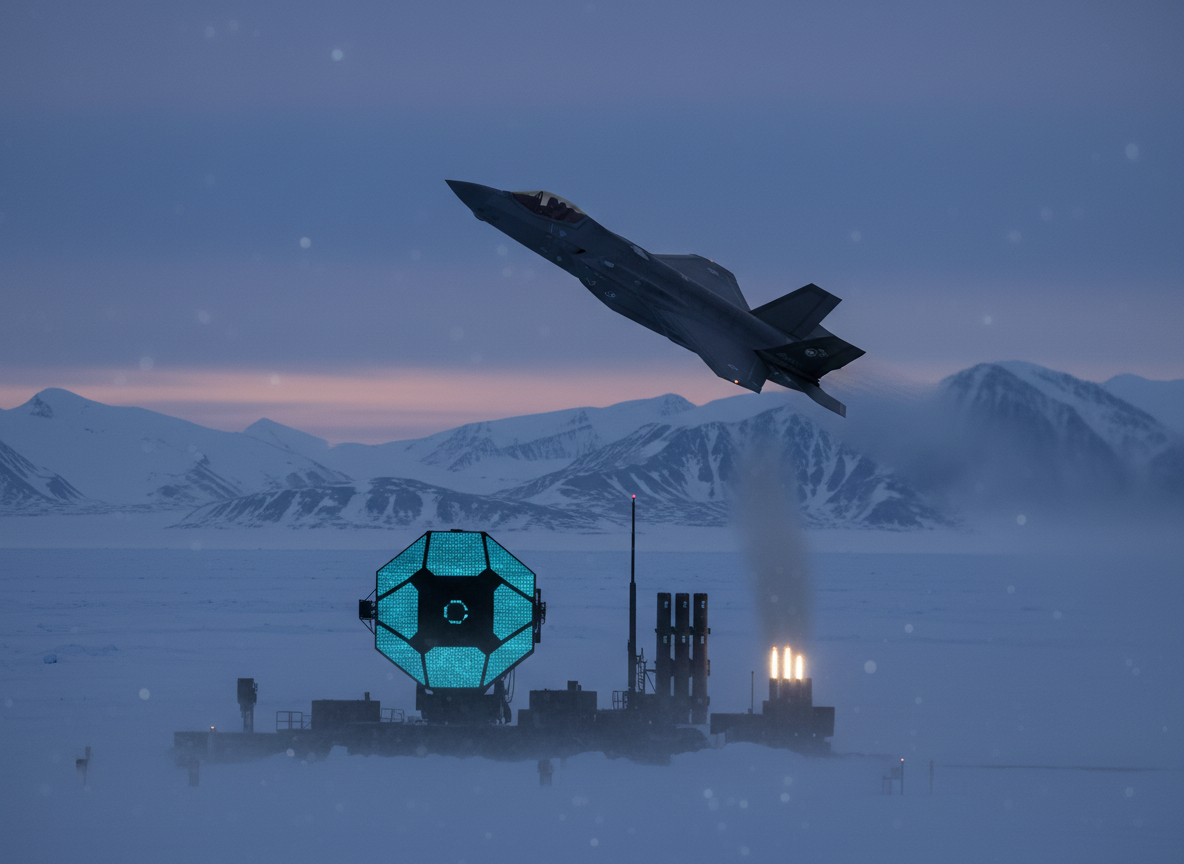
Arctic Defense Strategy Links Fighter Jet Debate to Missile Shield Ambitions
Tensions regarding North American security escalated this week as officials connected Canada's fighter jet program to a proposed missile shield. The dispute highlights growing pressure on Ottawa to maintain its full order of F-35 Lightning II aircraft to meet evolving threats in the High North.
Decades of Procurement Struggles Meet Evolving Northern Threats
Canada began its journey to modernize its air fleet in 1997, yet the path has remained rocky for nearly thirty years. The government committed $19 billion in 2023 for 88 stealth fighters, aiming for initial delivery by 2026, but domestic debates regarding costs continue to surface. These discussions now collide with Washington's renewed focus on the Arctic, where melting ice creates new security vulnerabilities. Former President Donald Trump has long advocated for a "Golden Dome" defense system, a concept that relies heavily on integrated air power across the continent to intercept ballistic threats. This creates a complex environment where military spending meets high-stakes geopolitics.
Ambassador Warns of Strategic Shifts in Defense Policy
The diplomatic discourse intensified after U.S. Ambassador Pete Hoekstra suggested the United States might act alone if Canadian contributions falter. He indicated that a reduction in Ottawa's fighter jet order could force Washington to increase its own fleet presence in Canadian airspace to secure NORAD objectives. While the State Department later clarified these remarks, the message underscored the critical nature of the F-35's role in continental architecture.
Integration with Missile Defense Plans
This pressure aligns with the ambitious "Golden Dome" initiative, a missile defense shield requiring seamless data sharing between allied forces. Furthermore, the strategy connects to broader territorial ambitions, including renewed American interest in Greenland as a strategic hub. Discussions in Ottawa have recently explored mixed fleets involving Swedish aircraft, but U.S. officials argue such moves could compromise the unified defense network. The focus remains on the interoperability of the F-35, which proponents argue is essential for tracking threats across the vast Arctic region.
Sovereignty Concerns Rise Alongside Military Requirements
A shift away from the full American stealth fighter program could fundamentally alter how North America defends its airspace. Experts warn that operating non-compatible aircraft might relegate Canada to a secondary role within its own territory, forcing the U.S. to shoulder more responsibility. This dynamic threatens to strain the bilateral relationship, potentially weakening Ottawa's claim over Arctic sovereignty just as international competition for northern resources intensifies.
Officials urge a swift resolution to ensure the alliance remains capable of facing modern geopolitical challenges. The coming months will prove decisive as the first scheduled jet deliveries approach and Arctic policy takes center stage.